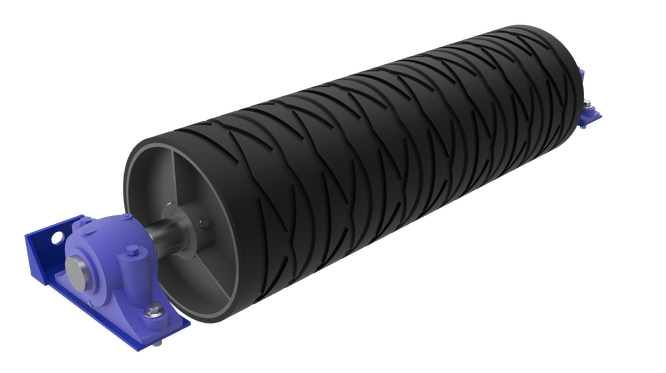
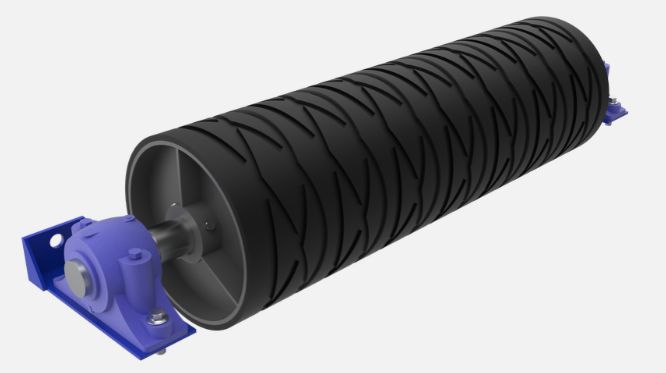
Conveyor pulleys are essential components that drive, redirect, and tension the conveyor belt at head, tail, snub, and bend points. Engineered to withstand high loads and harsh environments, they ensure smooth belt operation, minimize slippage, and optimize power transmission. Pulley design must conform to international standards such as CEMA, IS 11592, and ISO 5048 for performance, safety, and interchangeability.
Technical Specification
| Type | Function & Placement |
| Carrying Idlers | Support loaded belt; typically, 3-roll or 5-roll trough sets |
| Impact Idlers | Absorb shock at loading zones; protect belt from falling material |
| Return Idlers | Guide empty belt on return path; prevent sagging |
| Self-Aligning | Auto-correct belt misalignment; reduce edge wear |
| Transition Idlers | Adjust belt profile between flat and troughed sections |
| Feature | Description |
| Labyrinth Seals | Dust- and water-proof; extend bearing life |
| Mounting Frames | Modular brackets with standard bolt slots |
| Replacement Strategy | Quick-swap designs with standardized spindle ends |
| Precision Bearings | Rated for 25,000+ Hrs |
| CRCA Housings | Cold Rolled Close Annealed steel for strength and corrosion resistance |
| Troughing Angles | 20°, 35°, 45° |
| Run-Out Tolerance | ≤1.6 mm for idlers <1350 mm long (IS 8598); tighter in DIN/SANS specs |
© 2026 Strutron – Shiv Shakti Engineering Company. All rights reserved. | Designed & Developed by Blue Planet Design Studio